
- 2026-08-25
- by LethaldiranMX
- Trends
- 0 Comments

LethaldiranMX Insight
This utility bridges the gap between traditional WordPress content delivery and modern, markdown-centric workflows by offering clean, client-side and server-side Markdown conversion. By providing a Gutenberg block, shortcode, and a dedicated .md.txt endpoint, it caters heavily to technical audiences, documentation sites, and platforms aiming to feed content directly into LLMs or static site generators. The inclusion of granular CSS selectors for excluding elements like ads or navigation shows a deep understanding of real-world content scraping challenges, making it an excellent tool for developer-focused blogs and knowledge bases.
Best Fit & Operational Role: The plugin is an ideal fit for technical documentation portals, developer blogs, and sites designed to support content syndication or LLM ingestion pipelines. Operationally, it eliminates the need for external scraping tools or manual formatting by allowing users to export clean Markdown directly from the browser or programmatically via the .md.txt endpoint. It integrates smoothly into the WordPress block editor and layout engine without requiring complex build steps or heavy external dependencies.
Potential Limitations & Pitfalls: Enabling the .md.txt URL endpoint introduces custom rewrite rules and dynamic server-side HTML-to-Markdown conversion, which could increase CPU overhead on high-traffic sites if not paired with a robust page caching layer or CDN. Additionally, relying heavily on custom CSS selectors for content targeting means that any future theme redesign or DOM structure changes could break the Markdown parser’s accuracy, requiring ongoing maintenance. Beyond these operational considerations, no security risks or plugin conflicts were identified based on the available information.

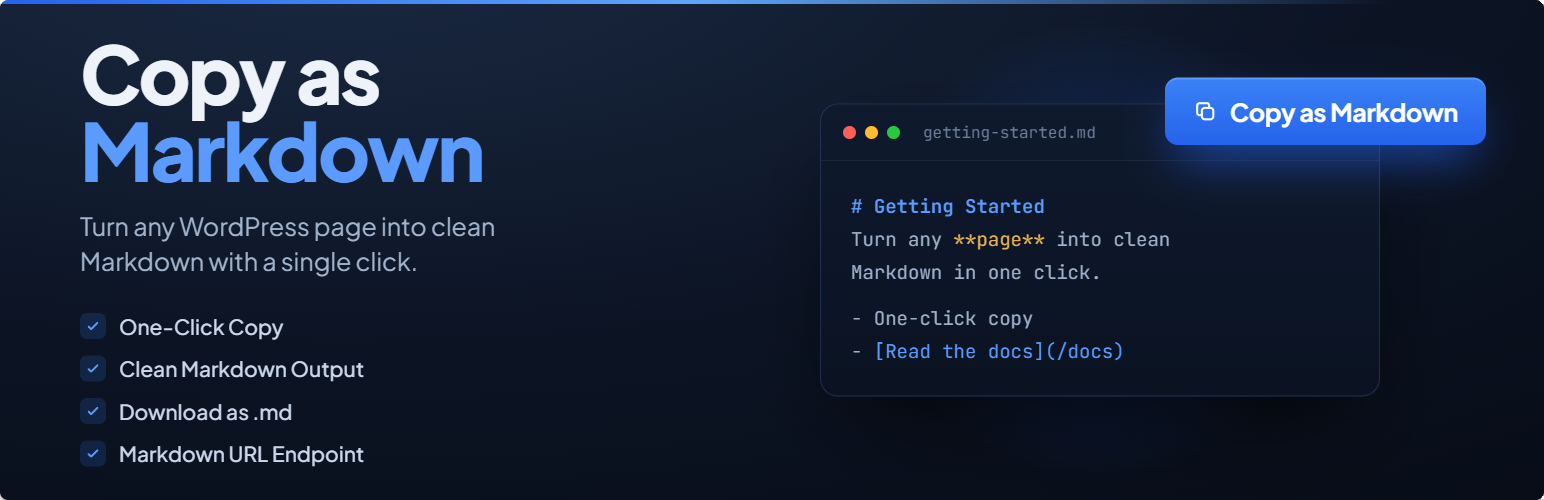
Adds a button to copy markdown, download, and view post as Markdown format. Supports shortcode, Gutenberg block and .md.txt endpoint.
Copy as Markdown Button lets your visitors copy any post or page content as clean, well-structured Markdown with a single click. It handles everything from headings and tables to code blocks and nested lists – no extra tools or dependencies required.
Placement & Auto-injection
- Automatically injects the button before or after the content on any combination of post types (posts, pages, and custom post types)
- Shortcode
[copy_as_markdown]for manual placement in any post, page, or widget - Gutenberg block available in the Widgets category – place it anywhere in the block editor with per-block overrides for button text, size, and content selector
- Exclude specific posts or pages from auto-injection by entering their IDs – shortcode and block placements are unaffected
Button Customisation
- Choose button size: Small, Medium, or Large
- Set custom background, text, and hover colours via colour pickers
- Adjust corner radius from 0 px (square) to 50 px (pill)
- Show or hide the copy icon alongside the button label
- Customise the button label (default: “Copy as Markdown”) and the success confirmation text (default: “Copied!”)
- Live preview in the settings panel updates instantly as you change style options
Content Control
- Optionally prepend the post title as a Markdown H1 heading
- Custom CSS selector to target a specific page element instead of the auto-detected content area
- Exclude any elements from the Markdown output using CSS selectors (one per line) – useful for stripping ads, share buttons, comment sections, and related posts
- Per-shortcode overrides for button text, size, content selector, and download button visibility
Download Button
- Optional dropdown “Download as .md” button that saves the converted Markdown as a
.mdfile directly from the browser, named after the post slug - Appears alongside the copy button in a split-button dropdown
- Can be force-enabled or force-disabled per shortcode instance using the
downloadattribute
Markdown URL Endpoint
- Enable a
.md.txtURL endpoint so any post or page can be viewed as plain-text Markdown by appending.md.txtto its URL (e.g.yoursite.com/your-post-slug.md.txt) - The server converts the post HTML to Markdown and serves it as
text/plain– useful for programmatic access, LLM ingestion, and content pipelines - Works with Elementor pages by using Elementor’s own renderer when available
- Optional “View as Markdown” link in the button dropdown opens the plain-text endpoint in a new tab
- Customisable link label for the “View as Markdown” item
HTML-to-Markdown Conversion
The converter handles a wide range of HTML elements cleanly:
- Headings (H1–H6), paragraphs, line breaks, and horizontal rules
- Bold (
**), italic (*), and strikethrough (~~) inline formatting - Hyperlinks with optional title attributes; images with alt text and titles
- Fenced code blocks with language detection from the
language-*CSS class - Inline code with backtick escaping
- Blockquotes with proper
>prefixing on every line - Ordered and unordered lists with full nested list support
- Tables converted to GitHub-Flavored Markdown pipe tables
- Figures with italicised captions
- YouTube iframe embeds converted to
[Video](url)Markdown links - Scripts, styles, navigation, and form elements are automatically stripped
Accessibility & Performance
- ARIA labels,
role="status"live region for screen-reader announcements after copy - Keyboard-navigable dropdown with
aria-expandedandrole="menu"semantics - Frontend CSS and JavaScript are only loaded on pages where the button will actually appear
Editorial note: This overview combines WordPress.org official plugin metadata with an AI-assisted LethaldiranMX editorial review. Plugin data should be verified on the official WordPress.org listing before installation.