

- 2026-06-14
- by LethaldiranMX
- Trends
- 0 Comments

LethaldiranMX Insight
COOKR addresses a critical flaw in traditional WordPress consent management by shifting script blocking from fragile client-side JavaScript execution to the server-side rendering pipeline. By leveraging the native WP_HTML_Tag_Processor to intercept and neutralize tracking scripts in the PHP output buffer, it eliminates the race conditions that often lead to non-compliant, pre-consent data transmission. This architecture provides developers and privacy-conscious site owners with a highly reliable, self-hosted enforcement mechanism that respects GDPR and TTDSG requirements without relying on external cloud dependencies.
Best Fit & Operational Role: This plugin is an ideal fit for agency developers, enterprise WordPress installations, and compliance officers who require verifiable GDPR enforcement rather than superficial consent theatre. Operating at the PHP level, it integrates directly into the WordPress rendering stack as a gatekeeper, ensuring that third-party scripts from Google Analytics, Meta, or YouTube are neutralized before the first byte reaches the browser. It solves the operational headache of managing complex tag manager triggers and client-side race conditions, making it a robust choice for highly regulated industries where data sovereignty and zero-data-leakage policies are strictly enforced.
Potential Limitations & Pitfalls: Parsing the PHP output buffer using WP_HTML_Tag_Processor introduces server-side processing overhead that can impact Time to First Byte (TTFB) on high-traffic sites if caching is misconfigured. Developers must carefully coordinate COOKR with caching layers like WP Rocket, LiteSpeed, or Autoptimize to ensure that cached pages do not bypass consent enforcement or serve pre-rendered, neutralized scripts to users who have already consented. Furthermore, highly customized or dynamically injected inline scripts may bypass the signature database, requiring manual configuration and testing via the runtime inspector to ensure complete coverage.

GDPR cookie consent with server-side script blocking. Prevent Google Analytics, GTM, Meta Pixel and third-party embeds from loading before consent.
GDPR cookie consent with real script blocking.
Block Google Analytics, Google Tag Manager, Meta Pixel, Hotjar, YouTube embeds, and other third-party services before they reach the browser.
Unlike JavaScript-based consent tools, blocked scripts never reach the browser at all.
Most cookie consent plugins display a banner and rely on JavaScript to stop tracking scripts. In many cases, those scripts can begin loading before the visitor has made a choice.
COOKR takes a different approach.
Scripts are blocked server-side before page delivery. Third-party services cannot execute until consent is explicitly granted. This helps website owners meet GDPR and TTDSG requirements more reliably.
Avoids the client-side race conditions common to JavaScript-only consent tools. No script guessing. No “hope it loads in time.”
Consent enforcement instead of consent theatre.
✓ Server-side script blocking — blocked before the browser receives them
✓ Google Consent Mode v2 support
✓ No external consent cloud
✓ No proxy infrastructure
✓ No visitor data sent to third parties
✓ Works entirely on your WordPress installation
Built for site owners, agencies, and developers who want real GDPR cookie consent enforcement.
COOKR CORE includes:
- Consent banner & preferences UI
- Server-side script interception via PHP output buffer
- Auto-Blocker for third-party scripts and iframes
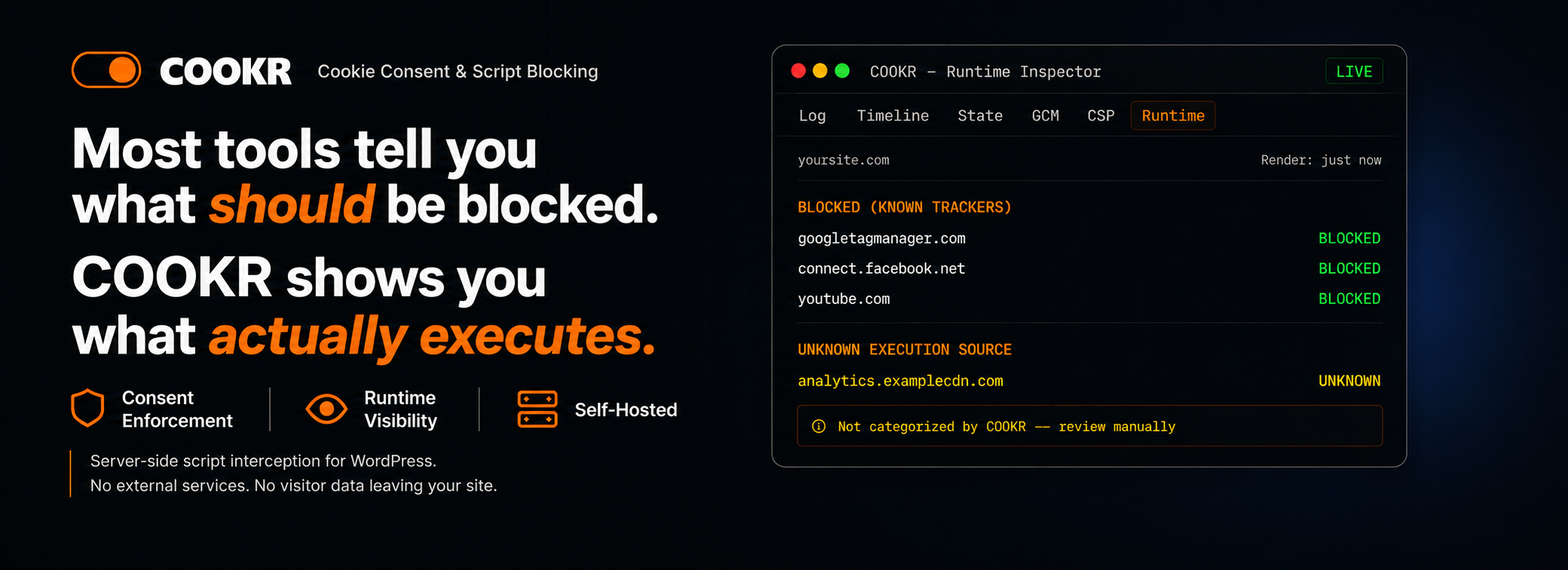
- Runtime Inspector
- CSP-aware restoration with nonce propagation
- Google Consent Mode v2 support
- Full JavaScript API (
window.cookrConsent) - Self-hosted operation — no external services required
COOKR RADR additionally includes:
- Privacy Radar — runtime detection and classification of third-party services
- Enforcement Verification Framework — structured protocol for proving enforcement claims
- Compatibility Matrix — tested stack database with VERIFIED/PARTIAL/UNKNOWN/FAILED states
- Automatic optimizer exclusions — LiteSpeed, WP Rocket, Autoptimize, FlyingPress
- Curated signature database with automatic weekly updates
How It Works
COOKR intercepts scripts in the PHP output buffer using WP_HTML_Tag_Processor before delivery to the browser. Matching script and iframe tags are neutralised server-side and restored only after the visitor grants consent.
There is no client-side race condition because blocking happens before the browser receives the page.
Auto-Blocker
Enable in Settings. Off by default.
When enabled, COOKR rewrites matching script tags and iframe tags server-side — setting type="text/plain" and preserving original attributes in data-cookr-* attributes for restoration after consent.
Test after enabling when using WP Rocket, LiteSpeed Cache, NitroPack, or Cloudflare Rocket Loader.
Runtime Inspector
The Runtime Inspector exposes third-party runtime activity directly in the browser — blocked scripts, restored services, iframe activity, detected domains.
Enable in Settings. Append ?cookr_debug=1 to any frontend URL while logged in as administrator.
CSP-aware
COOKR supports strict Content Security Policies without requiring unsafe-inline.
Restored scripts preserve CSP integrity via automatic nonce propagation. COOKR reads the nonce WordPress assigns to enqueued scripts at request time and passes it to restored scripts — no manual configuration required.
Developer JS API
cookrConsent.has('analytics')
cookrConsent.require('marketing', callback)
cookrConsent.whenConsented('analytics').then(fn)
cookrConsent.on('consent' | 'change' | 'decline' | 'reset', handler)
cookrConsent.off(event, handler)
cookrConsent.getConsent()
cookrConsent.getExpiry()
cookrConsent.categories()
cookrConsent.reset()
Consent Categories
- Necessary — Always active.
- Analytics — GA, GTM, Matomo, Hotjar, Clarity, etc.
- Marketing — Meta Pixel, Google Ads, TikTok, LinkedIn, etc.
- External Media — YouTube, Vimeo, Google Maps, etc.
Does COOKR require an external cloud service?
No. COOKR runs entirely on your WordPress installation.
Does visitor consent data leave the server?
No. Consent data is stored locally on your site.
Is the Auto-Blocker enabled by default?
No. Enable and test it after installation, particularly when using caching or JavaScript optimization plugins.
Which services can be blocked?
Any third-party script or iframe matching configured domains. Examples: Google Tag Manager, Meta Pixel, YouTube embeds, TikTok Analytics.
Does COOKR support Google Consent Mode v2?
Yes. Enable in settings when using GTM or GA4.
How do I inspect runtime activity?
Enable the Runtime Inspector in settings and append ?cookr_debug=1 to any frontend URL while logged in as administrator.
Does COOKR store personal data?
The consent log stores a hashed IP (not the raw IP address), consent choices, and a timestamp. The raw IP address is never stored.
Is COOKR compatible with strict CSP?
Yes. COOKR automatically reads the nonce WordPress assigns to enqueued scripts and passes it to restored scripts, preserving compatibility with strict-dynamic CSP policies. No manual configuration is required.
Will COOKR work with caching plugins such as LiteSpeed Cache, WP Rocket, or Cloudflare?
Yes, but always test after enabling script optimization features such as JavaScript combine, defer, delay, or Rocket Loader. COOKR performs script blocking server-side, but aggressive optimization plugins may alter script delivery and should be verified on your site.
RADR v1.9.8 adds automatic exclusion filters for LiteSpeed Cache, WP Rocket, Autoptimize, and FlyingPress — COOKR registers itself as excluded from JS combination pipelines automatically.
Does COOKR require HTTPS?
Yes. COOKR requires HTTPS for consent state to persist correctly across page loads. Modern browsers restrict cookie behaviour on HTTP origins — on HTTP, the consent cookie may not persist, causing the banner to reappear on every page load. HTTPS is also a legal recommendation under GDPR for any site collecting consent.
What WordPress version is required?
WordPress 6.2 or higher. COOKR uses WP_HTML_Tag_Processor for safe, attribute-aware script rewriting, introduced in WP 6.2.
External Services
This plugin does not connect to any external service by default.
The auto-blocker contains a built-in list of known third-party domains (such as googletagmanager.com, connect.facebook.net, maps.googleapis.com, etc.) that is used purely as a local reference to identify and block scripts before consent. No data is sent to these domains by this plugin — the list is pattern-matching data stored locally in the plugin code.
Editorial note: This overview combines WordPress.org official plugin metadata with an AI-assisted LethaldiranMX editorial review. Plugin data should be verified on the official WordPress.org listing before installation.